


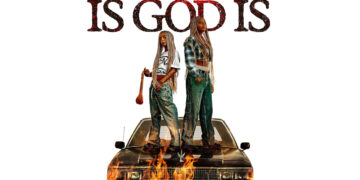













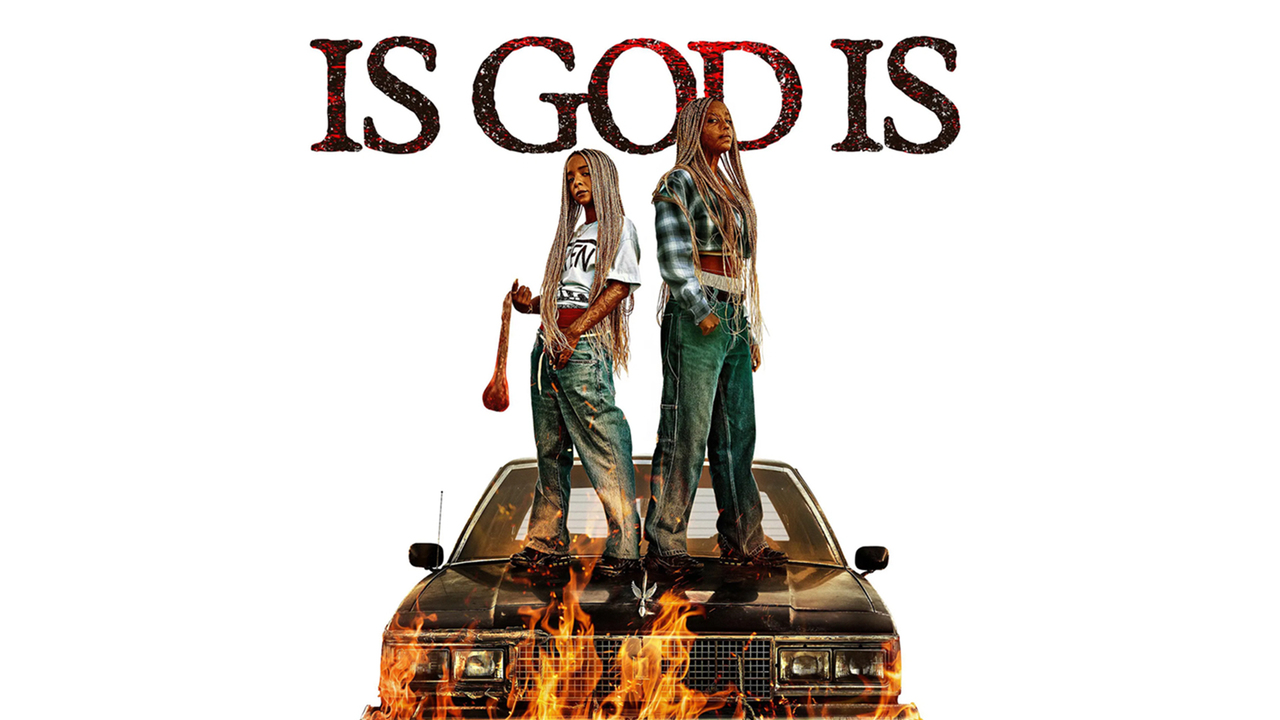
With it currently being Gemini season, the astrological sign represented by celestial twins, there may be no more fitting time for the religious revenge thriller Is God Is. Marking its Off-Broadway debut in 2018, the work from critically acclaimed playwright Aleshea Harris has since made the transition from stage to screen.
The story begins with a flashback of two young foster girls sitting on a playground bench as they endure cruel taunts about their appearance. We quickly learn that these girls are inseparable twin sisters, Racine (Kara Young) and Anaia (Mallori Johnson). The pair do everything under the sun together—eating, sleeping, and navigating the world side by side. Racine is the more dominant twin: fiery, outspoken, impulsive, and fiercely protective. Anaia, by contrast, serves as her counterpart, approaching life with greater sensitivity and emotional awareness, especially as the sibling often targeted by others for her looks. They are fire and ice, and despite their differences, the sisters share an extraordinary bond. “If one finds trouble, the other can feel it,” capable of sensing each other’s thoughts, emotions, and even physical pain. Whether it’s a sudden feeling of danger, the sting of burning skin, or an ache deep in their bones, their experiences reverberate between them and “Where Racine goes, Nia always gone follow.” Believing themselves to be parentless and alone in the world, their reality shifts when they receive an unexpected note from their mother, Ruby the God (Vivica A. Fox), whose final wish is to reunite with the daughters she left behind.
Down in the Dirty South, the sisters finally come face-to-face with the mother they never knew, a severely burned Ruby the God, attended to by caretakers who braid her hair with long acrylic nails. As they twist and weave each strand, the sharp clinking of their nails echoes through the room, evoking the deeply rooted connection between Black women, their hair, and the labor, care, and grief often carried within those rituals. The sight of their mother leaves the sisters stunned and speechless in the face of a reality they never expected. Confined to her bed and scarred by fire, Ruby appears even more physically damaged than the daughters who have spent their lives being mocked for their looks. Yet despite her appearance, there is no fearsome monster before them, as she ironically places a lit blunt to her mouth. Across years of separation and beneath layers of burned skin, the resemblance between mother and daughters is unmistakable. They share the same box braids, the same extra-long French tips, and the same undeniable presence. Even on her deathbed, Ruby embodies a distinctly resilient Black womanhood—her beauty, identity, and sense of self remaining intact despite everything that has been taken from her.
Ruby explains that her absence was never born out of abandonment, but out of a desire to protect her daughters. Life was already difficult for Racine and Anaia as burn survivors, and she believed that growing up with a mother she describes as having “alligator skin” would only intensify the cruelty and judgment they faced from the world. Years earlier, the twins’ estranged and abusive father (Sterling K. Brown) violently forced his way into their home and set Ruby on fire. In a desperate attempt to save their mother from the flames, Racine and Anaia were burned as well, leaving all three marked by the same traumatic event. Now, as Ruby nears the end of her life, she reveals the true reason she summoned her daughters. Her final wish is not reconciliation or forgiveness, but revenge. She tasks the sisters with carrying out a mission she can no longer complete herself: to hunt down the man who destroyed their family and make him pay for what he did. As Ruby tells them, they must “make yo daddy dead—kill his spirit, then his body… like he did me. Destroy him and everything around him.” What follows is not simply a quest for vengeance, but a reckoning with generational trauma, inherited pain, and the scars, both physical and emotional that continue to shape their lives.
This is a road-trip revenge tale, as the girls set out on a mission for their mama to seek vengeance against the man who set their lives aflame before they could even live them. As they travel across the South in search of their father, they encounter the five remnants of his past. The first is Divine the Healer (Erika Alexander), a heavily scarred cult leader and self-proclaimed preacher who cloaks her trauma and delusions in religious devotion. Sharing a son, Ezekiel (Josiah Cross), with the twins’ father, Divine has spent three decades waiting for his return. Despite his long history of abuse—setting his wife on fire, traumatizing his children, abandoning his family, changing his identity, and building an entirely new life, she remains convinced that he is worthy of redemption. In her mind, his soul is sanctified, simply awaiting the right woman to save him. Divine becomes a fascinating embodiment of how faith can sometimes be weaponized to excuse harmful behavior. Through her, the film explores the ways some women are conditioned to nurture narcissistic men, use religion to justify their actions, and absorb the damage caused by toxic masculinity. The sisters next encounter Chuck Hall (Mykelti Williamson), their father’s former defense attorney. Though his role is more restrained, Williamson delivers a commanding presence. Serving almost as a moral warning along the twins’ journey, Chuck cautions them to be careful with vengeance, reminding them that revenge is an emotion powerful enough to consume those who pursue it. His warning that you never truly know where the blood will land hangs over the film as a reminder that violence rarely ends with its intended target.
Finally, the sisters arrive at their ultimate destination: the place where their father has built a new life. He now lives comfortably in a lavish home with his wife, Angie (Janelle Monáe). At first glance, Angie’s life resembles a picture-perfect suburban dream, but beneath the surface lies a woman trapped in a toxic and violent marriage. She spends her days catering to her husband’s every demand, carefully maintaining a household designed around his comfort rather than her own. Throughout the film’s gritty, neo-Western revenge odyssey, Angie’s journey becomes one of self-discovery and liberation. As she begins to recognize the reality of her situation, she slowly finds the courage to imagine a life beyond her husband’s control. Her arc culminates in the realization that freedom requires action, not endurance. As Angie reflects, “a woman who knows her worth would have left,” a line that speaks to both her regret and her newfound clarity. Adding another layer of irony, Angie and the twins’ father share twin sons of their own: Scotch (Xavier Mills) and Riley (Justen Ross). Like Racine and Anaia, the brothers are opposites who nevertheless mirror one another. Scotch conceals his vulnerabilities behind recklessness and bravado, while Riley is reserved, observant, and still. Together, they serve as reflections of their half-sisters—the father’s “first kids” suggesting that despite his efforts to reinvent himself, the patterns of his life continue to repeat.
By the time the long-awaited confrontation arrives, the film has spent its entire runtime building toward this moment. The father’s identity remains largely obscured throughout the story; viewers see only fragments of him—his mouth, his frame, his presence, while his face is withheld. The effect transforms him into something larger than a man: a looming specter whose violence has shaped the lives of everyone around him. When he is finally revealed, the reality is both unsurprising and devastating. He is handsome, charismatic, and outwardly unremarkable, the kind of man Ruby once described when she warned that “men like your daddy always got a tender side.” Yet beneath that exterior, nothing has changed; time has not softened him, nor has it absolved him of his cruelty. His sins remain visible in every scar, every broken relationship, and every life left in his wake. What makes the revelation particularly powerful is how the film positions the women surrounding him. Ruby, Divine, and Angie each represent different chapters of his life, but they are connected by a common thread: each, in her own way, was asked to carry the burden of his violence. Is God Is suggests that behind many abusive men stands someone willing or conditioned to excuse, protect, or save them. At every stage of his life, another woman arrived prepared to sacrifice herself for his redemption, while he remained unwilling to redeem himself. In many ways, the twins’ entire existence is shaped by the choices and violence of their parents, “they come come from a man who tried to kill our mama and a mama who wants to kill that man.” Though the sisters grew up estranged from both parents, revenge, rage, and grief are part of their bloodline. Racine inherits her parents’ fury; she smokes like them, speaks with their fire, and carries a soul consumed by vengeance. Anaia inherits their emotional depth, approaching the world with sensitivity, empathy, and compassion even when violence surrounds her.
Religious imagery runs deep throughout Is God Is; there is a recurring motif that Ruby is, quite literally, her daughters’ God. Upon arriving to meet their mother for the first time, Racine asks Anaia, “ready to see God?” Reinforcing the idea that because she created them, she is their higher being. Racine comes to view herself as “the hand of God doing her bidding,” carrying out her mother’s final command with near-religious conviction. The symbolism of the Gemini twins is equally significant, there is also a cultural resonance to the idea of “twin.” Within Black communities and AAVE, “twin” is often used as a term of endearment for someone with whom you share a deep connection or understanding. While Racine and Anaia come from the same womb, Harris presents their bond as something spiritual and emotionally connected. Fire and water, rage and compassion, action and reflection. Harris further reinforces this duality through the introduction of the twins’ half-brothers, Scotch and Riley. As another set of twins, they serve as mirrors of Racine and Anaia, an alternate reflection of what the siblings might have become under different circumstances. Their presence creates a fascinating parallel between the father’s first family and the one he attempted to build afterward. External vs internal beauty also emerges as one of the film’s most poignant themes. “All God’s children are beautiful” constitutes more than simply a sentiment; it is a call to a society that often marginalizes Black women and confines them to arbitrary expectations. Through burn scars, trauma, and years of emotional wounds, the film repeatedly asks who gets to be considered beautiful and who has the authority to define it. The solution lies not in external beauty, but in resilience, survival, and self-worth. There is a death and rebirth philosophy where each character is compelled to confront ancestral versions of themselves, bury inherited grief, and decide whether to prolong cycles of violence or transform into something new.
Ultimately, Is God Is is a Neo-Western revenge tale that gives Black women the space to be complex, enraged, imperfect, mourning, and powerful.