









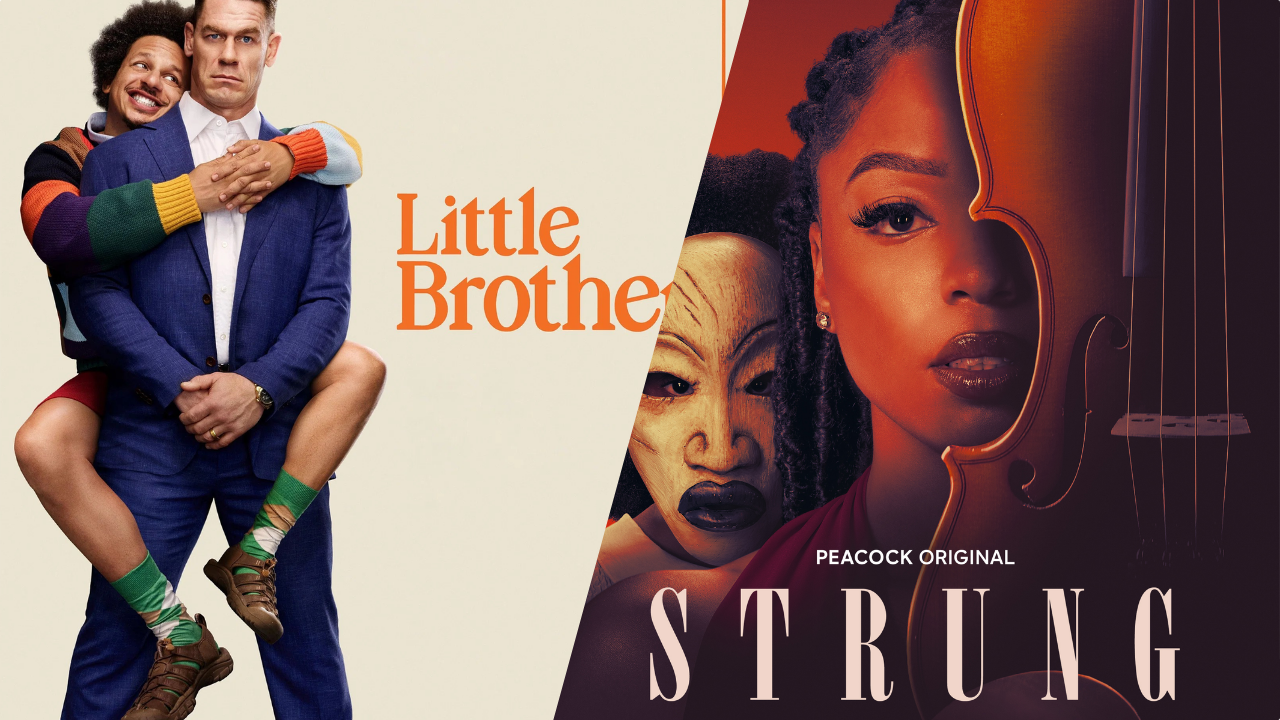
Netflix has become increasingly fond of the odd-couple comedy, and Little Brother, directed by Matt Spicer and written by Jarrad Paul and Andrew Mogel, comfortably joins that growing catalog.
The film follows Rudd Landy (John Cena), a polished New York real estate agent whose carefully curated life is thrown into chaos when Marcus (Eric André), the eccentric foster brother he hasn’t seen in decades, unexpectedly resurfaces after escaping a psychiatric facility. Convinced his “brotha” is in desperate need of saving, Marcus barges back into Rudd’s life, forcing him to confront a past he thought he had left behind.
Although the two once bonded through a YMCA “Big Brother” mentorship program and declared themselves “brothers for life,” time has pulled them in drastically different directions. Rudd has built the picture-perfect suburban life—a successful career, a beautiful family, and the constant pursuit of proving himself to his older brother, Josh (Christopher Meloni). Marcus, meanwhile, has spent his life drifting through the foster care system, clinging to the only meaningful connection he ever had.
Little Brother leans on familiar odd-couple and fish-out-of-water comedy tropes, its greatest strength lies in its cast. Eric André’s unpredictable comedic energy plays effortlessly against John Cena’s strait-laced persona, creating a dynamic that consistently delivers laughs. Supporting performances from Ego Nwodim, Caleb Hearon, and Sherry Cola further elevate the film, each adding their own eccentric flavor to the ensemble. The recurring “brotha” banter between Rudd and Marcus may become repetitive, but it reinforces the film’s central message about chosen family, acceptance, and belonging not always by blood.
Little Brother is ultimately a breezy, low-stakes comedy designed for a casual Friday night watch. It may not leave a lasting impression, but its charming performances and commitment to its ridiculous premise make for an entertaining addition to Netflix’s comedy lineup.
One half of the Bailey sisters, Chloe Bailey has established herself as a multifaceted performer, earning recognition for her solo music career with In Pieces, Trouble in Paradise, and her recent collaboration with Timbaland, Resurrection. On screen, she has continued to gravitate toward music-driven roles, from Let It Shine and Joyful Noise to leading Peacock’s Praise This. With Strung, Bailey trades the stage for psychological horror, delivering one of her most layered performances to date.
Produced by Tyler Perry and Jason Blum, from a screenplay by Alan B. McElroy (Spawn) and directed by Malcolm D. Lee, Strung follows Laila (Bailey), an ambitious violinist haunted by recurring nightmares as she relentlessly pursues admission into an elite conservatory. After accepting a lucrative live-in tutoring position for a wealthy Los Angeles family, Laila quickly realizes the opportunity comes with unsettling rules, hidden agendas, and a household burdened by grief.
Bailey anchors the film with a performance that balances vulnerability and quiet determination. Laila’s relationship with music becomes an extension of her emotional state, as the violin serves not only as her artistic ambition but also as a conduit for trauma, memory, and fear. The opening nightmare sequence immediately establishes the film’s uneasy atmosphere, blending body horror with psychological dread before settling into a slow-burning mystery.Lynn Whitfield is commanding as Audra, the wealthy family matriarch whose polished exterior conceals calculated intentions, while Anna Diop, Coco Jones, and Lucien Laviscount round out a cast that effectively sustains the film’s mounting tension and strengthens the material.
Music is as integral to Strung as its horror. The score by Ali Shaheed Muhammad and Adrian Younge creates an ominous atmosphere that mirrors Laila’s deteriorating mental state, while music supervisor Erica Grayson assembles a soundtrack that weaves together classical, jazz, and hip-hop influences. Casting musicians such as Chloe Bailey, Coco Jones, and Pardison Fontaine lends an added authenticity to the film’s musical momentum.
Beyond its supernatural elements, Strung explores themes of grief, inherited trauma, and cultural identity. African iconography, ancestral symbolism, and references to Zulu traditions are woven throughout the family’s home, grounding the horror in questions of legacy, memory, and generational wounds rather than relying solely on conventional scares.
Strung works by allowing its psychological tension and musical identity to work in harmony. The grand performances and evocative visual and sonic palette,offers a distinctive blend of mystery, psychological horror, and supernatural folklore that lingers long after the final note.