











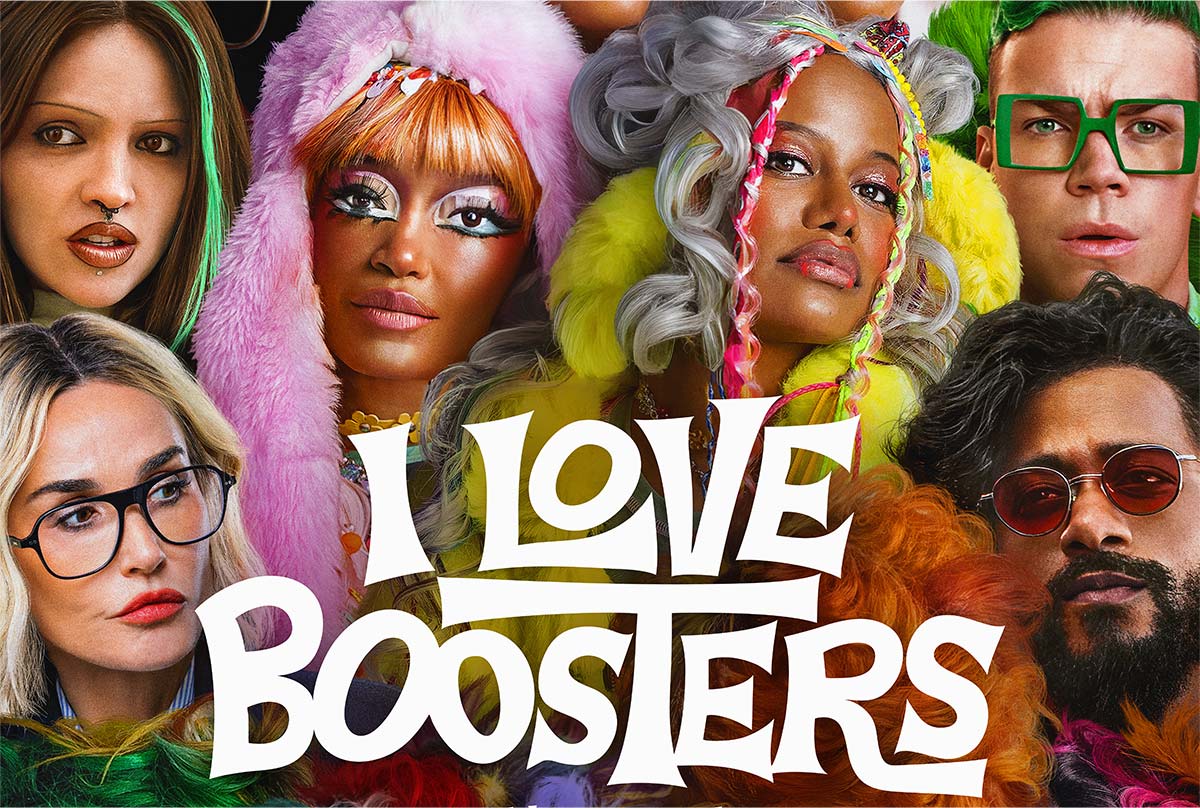
Director and writer Boots Riley invites audiences into his whacky world of chaos, couture, creativity, and anti-capitalist satire with his latest film, I Love Boosters. Set in the heart of the Bay Area, the film follows the “Velvet Gang,” a trio of booster baddies led by Corvette (Keke Palmer), alongside Mariah (Taylour Paige) and Sade (Naomi Ackie). With boosting at an all-time high, the women make a living stealing designer clothing and reselling it at more accessible prices, turning fashion into both a hustle and a statement.
Amid the colorful mayhem, Corvette finds herself squatting in an abandoned chicken restaurant while dreaming of a bigger life as a fashion designer. Beneath her confidence is a lingering loneliness that follows her through every room she enters. “I just feel lonely, even when I’m around people. People don’t see me,” she says, a surprisingly tender sentiment at the center of Riley’s otherwise delightfully whacky and rebellious satire.
I Love Boosters is commentary on socialism and class divide, examining how the working class is often dismissed as lazy or unwilling to find “real jobs,” while corporations profit from their labor. Christie Smith (Demi Moore), the charismatic CEO of luxury fashion giant Metro Designer, has built an empire around the belief that she can “change humanity’s perception through color and magic.” Every Metro location is assigned a designated Metro-chrome color from the rainbow spectrum, workers are expected to purchase Metro apparel, remain on theme, and devote themselves entirely to the company, all while earning laughably low wages. Employees Violeta (Eiza González) and Mansion (Najah Bradley) take home meager paychecks, exposing the absurdity of a system that demands loyalty to fully commit to the brand’s carefully curated aesthetic, while offering little in return. Adding to the satire is Grayson (Will Poulter), the smug and self-important Metro manager who insists that brand standards can only be maintained through mandatory in-season wardrobes, relentless productivity, and absurdly short lunch breaks. Meanwhile, his boss Christie Smith does not even know of his existence. Through Metro Designer, Riley skewers the contradictions and colorful facades of modern capitalism, exposing a world where image is valued far more than the people sustaining it.
Corvette and Christie’s worlds inevitably collide when the Velvet Gang begins stealing and repackaging merchandise from Metro Designer stores. Corvette uses Instagram to promote her fashion designs; to her they are only socially acceptable in virtual spaces, yet “too weird” for an official fashion competition. Things quickly take a drastic turn of events when she discovers an exact replica of her submission featured in Metro’s upcoming collection. As the design becomes a sensation, consumers praise Christie for understanding “what the streets want,” while the audience knows the truth: Corvette is the creative force behind the trend, erased from the narrative and denied recognition for her work. Christie freely mines the creativity, style, and cultural influence of the very communities she dismisses, insisting they possess neither taste nor imagination
In an act of retaliation, the colorful crew cleans out Metro stores across the Bay Area. Christie continues to publicly scrutinize the boosters for reselling her products out of backyards, back trunks, and bathrooms. To Christie, they are nothing more than “low-class urban bitches” threatening her profit margins. What she fails to recognize is that she and the boosters are engaged in the same hustle, only at different ends of the economic spectrum. While Christie condemns the crew for cutting into her business, the film repeatedly underscores that Metro’s exorbitant prices are precisely what push consumers away from the brand in the first place. One form of theft is rebranded as innovation and entrepreneurship; the other is criminalized. Through Corvette and Christie, Riley exposes how capitalism often rewards exploitation when it comes from the top while punishing survival when it comes from the bottom.
As if the film were not already bursting at the seams with ideas, Riley introduces a plethora of side characters. There is a romance between “two lonely souls,” Corvette and Pinky Ring Guy (LaKeith Stanfield), a mysterious model rumored to literally consume the literal souls of his lovers. ‘The Forged Democracy Think Group’ which makes up a select otherworldly avatars, beneath the skin suits, they are disguised as humans and role-play: “crying Black mother” (Kara Young), Dr. Jack (Don Cheadle), and “Based Young Dude” (Jermaine Fowler). These characters spew an agenda that entails police enforcement, rent control, the erasure of homelessness, and cooperate hierarchy.
Meanwhile, across the globe, Metro Designer’s factory workers in China endure grueling hours, dangerous working conditions, and poverty wages while producing the very products that fuel Christie’s empire. When factory worker Jianhu (Poppy Liu) discovers a device known as the Teleporter—originally designed to eliminate shipping costs through instantaneous transportation. The device has three modes: “atomic designer, deconstruct, and accelerator,” and she uses it to redistribute Metro’s inventory until the workers’ demands are met. Enraged by the disruption to her business, Christie refuses to negotiate, prompting Jianhu and the Velvet Gang to join forces in an act of rebellion that culminates in a chaotic showdown at Metro’s fashion show. Their mission is simple: “deconstruct the clothes, not the people.”
One of the film’s most memorable visual motifs is a gigantic rolling mass of fabric, clothing, overdue bills, and financial anxiety that follows Corvette throughout Oakland. Growing larger with every passing scene, it becomes a powerful symbol for the tangled relationship between fashion, consumerism, debt, and creative identity. Riley references real stores for everyday people like: Jcpenney, Walmart, Ross, Tjmaxx, and Target. Through a series of eccentric side characters and increasingly surreal detours, he examines how systems of power package, monetize, and repurpose human expression for profit. In Riley’s world, creativity is not merely a commodity to be bought and sold; it is something constantly at risk of being swallowed whole by the very systems that claim to celebrate it. He
Oscar-nominated costume designer Shirley Kurata proves indispensable to the film’s visual architecture, crafting a wardrobe that is at once exuberant, subversive, and meticulously intentional. Her candy-saturated designs do more than adorn the characters; they function as an extension of the film’s ideological framework, transforming fashion into a site of rebellion, aspiration, and cultural authorship. Every garment feels curated from the collision of fantasy and consumerism, reinforcing the film’s ongoing interrogation of who creates culture and who ultimately profits from it. Riley’s visual language is equally distinctive; through the use of miniatures, matte paintings, and custom anamorphic lenses, he constructs a heightened reality that exists somewhere between fable, satire, and dreamscape. The film’s aesthetic is textured, handmade, and delightfully unruly, mirroring the anti-establishment spirit at the center of its narrative. The sonic landscape featuring Tune-Yards’ score and accompanying vocals performed by Keke Palmer, pulses through the film with restless energy, effortlessly shifting between mischief, melancholy, and momentum.
Beneath its colorful absurdity, I Love Boosters is a sharp satire about classism, capitalism, labor exploitation, and the commodification of creativity. Riley argues that corporations routinely profit from the imagination, labor, and culture of everyday people while denying them ownership of their contributions.
I Love Boosters is Boots Riley’s latest act of cinematic provocation; a kaleidoscopic collision of couture, class consciousness, creativity, and anti-capitalist critique. Anchored by a stellar ensemble and an unwavering commitment to artistic audacity, the film reaffirms Riley as one of the contemporary voices capable of translating radical political inquiry into something vibrant, hilarious, and wholly unforgettable