

















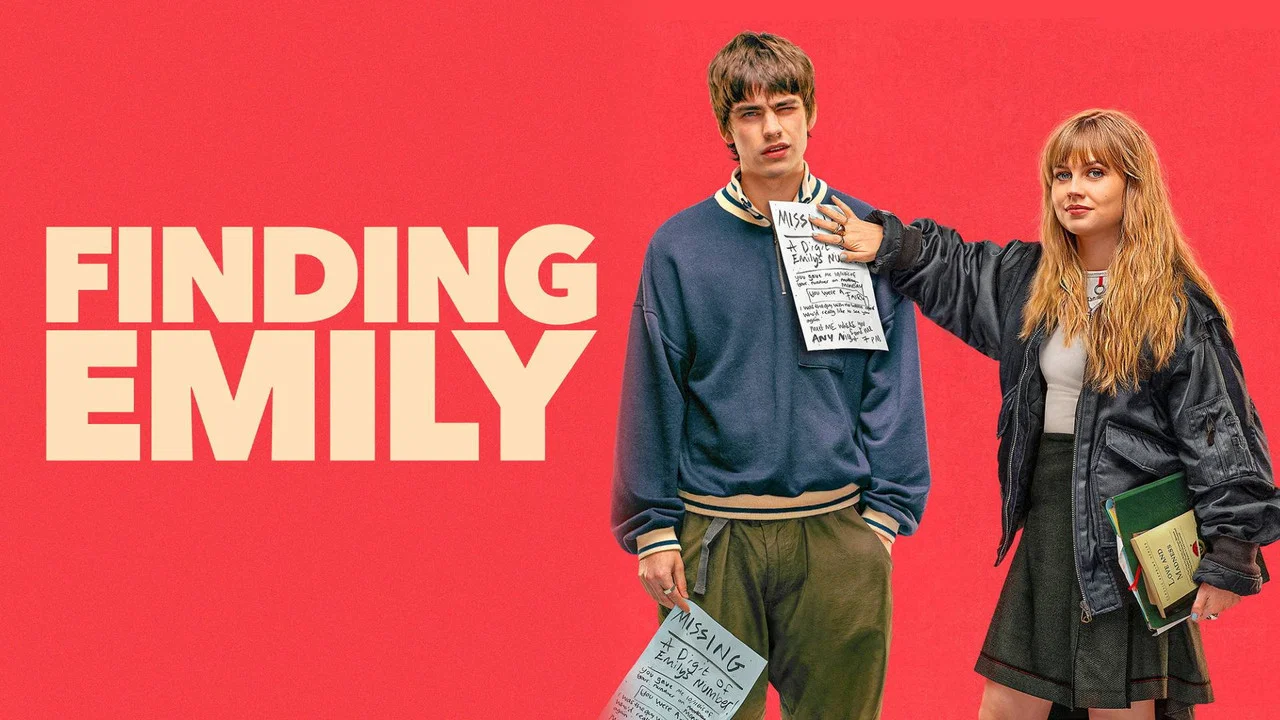
In recent years, the name Emily has become a cinematic fixture, appearing in titles ranging from Emily in Paris to Emily the Criminal. Now Writer Rachel Hirons and director Alicia MacDonald offer another variation with Finding Emily, a British rom-com that takes the familiar pursuit of romance. “Love is a state of temporary psychosis,” attributed to Sigmund Freud, appears at the opening of the film, setting the stage for a story in which infatuation is both intoxicating and potentially delusional.
Set in Manchester, England, Finding Emily follows Owen (Spike Fearn), a musician working as a club sound engineer. One night, he meets Emily (Sadie Soverall), a manic-pixie-dream-girl-like stranger who immediately captures his attention. Their encounter is brief but electric, culminating in a night of dancing and an undeniable spark. The following morning, Owen realizes that all he has left is a scrap of paper bearing her name and an incomplete seven-digit phone number.
Unable to shake the memory of their night together, he launches into a frantic campus-wide search for “this girl called Emily.” His romantic quest eventually leads him to Emily Raine (Angourie Rice), an American psychology student at the University of Manchester conducting a study on romantic attachment. Facing the possibility of returning to Ireland without a postgraduate plan, Emily needs a successful case study and Owen, completely unaware that he has become her subject, provides the perfect specimen.
The irony is that Owen is searching for one Emily while inadvertently becoming another Emily’s research project. His pursuit quickly spirals, accidentally CC’ing all 318 “Evening Emilys” at the university; Owen becomes known anonymously as the “Email Guy.” What begins, from his perspective, as an earnest romantic gesture is interpreted by others through a much less forgiving lens. His behavior becomes a campus-wide debate: Is this harmless romantic persistence, or sexual harassment? Suddenly, Owen accumulates labels faster than he can write love songs: stalker, serenading romantic, weird email guy, “sexy pest,” “sex pest” and even “rapist virgin.” A campus #MeToo movement emerges, with students proclaiming “I am Emily” and “Not Emily’s Type.” The film’s sharpest observations emerge from this disconnect between intention and perception.
To those who know Owen, he is simply an earnest, somewhat intense romantic—a musician who falls hard, writes songs about the woman who inspires him and believes wholeheartedly in the grand gestures of love. To strangers, however, the same behavior can look invasive, obsessive and threatening. Finding Emily refuses to give Owen the comfort of assuming that good intentions automatically absolve questionable behavior.
That tension becomes the film’s central interrogation of modern romance. We are living, as the movie puts it, in “the year of yearning,” a cultural moment in which romantic longing has become almost performative. Owen embodies the archetype of the sensitive musician heartthrob who turns women into muses and mistakes intensity for intimacy. The film knowingly skewers that fantasy with the blunt admonition: “Stop fetishizing white boys who play the guitar,” and it is funny because there is some truth beneath the joke.
Finding Emily is less interested in whether Owen is a “good guy” or a “bad guy” than in examining the entitlement that can accompany romantic pursuit. His desire becomes the organizing principle of the search, but Emily is not necessarily interested in being found. The film repeatedly returns to the question Owen fails to ask: What does Emily want? That question becomes particularly important because Owen initially treats Emily less as an autonomous person than as the protagonist in his own romantic narrative. She becomes a muse, an idea, a face attached to a fantasy. His love letters and songs may feel deeply personal to him, but they are built around a version of Emily that exists largely inside his imagination.
Owen’s eventual humiliation, however, becomes strangely humanizing and the fantasy collapses, forcing him to confront the uncomfortable distinction between loving someone and loving the idea of them. In that sense, his downfall is necessary: He has to lose control of the narrative before he can recognize Emily as a person outside of it.
The film also has plenty of fun with the language of contemporary internet culture. There is no shortage of Twitter-thread discourse, TikTok therapy speak and quick-fire one-liners, all of which give Finding Emily a distinctly online sensibility. At times, the dialogue feels as though it has been pulled directly from the comment section of a viral relationship discourse, but that heightened digital vocabulary is part of the film’s point. Romance no longer exists solely between two people; it is increasingly mediated, documented and scrutinized by everyone watching from the outside.
In that regard, Finding Emily understands the modern dating landscape as a kind of digital spectacle. Parasocial relationships, attachment theory and social-media surveillance all become part of the romantic ecosystem, creating a world in which intimacy can feel simultaneously more accessible and more impersonal.
The performances help sell the film’s eccentricity; Fearn brings an appealing vulnerability to Owen, allowing his character to remain sympathetic even when his behavior becomes increasingly questionable. Rice gives Emily an intellectual sharpness that prevents her from becoming merely a device in Owen’s romantic journey, while Soverall makes the original Emily magnetic enough to justify the obsession that sets the entire story in motion. Their chemistry gives the film its romantic pulse, even as the screenplay keeps asking whether chemistry alone is enough to justify pursuit.
Manchester itself also emerges as more than a backdrop, the city has a lived-in quality that complements the film’s messy, youthful energy, with its clubs, university spaces and nightlife becoming part of the emotional landscape. It feels like a city where a chance encounter can become a life-altering obsession or at least… a really complicated campus-wide email chain.
Finding Emily is a quirky, heavy-hitting British rom-com buoyed by charming performances and an unconventional premise. Rather than simply recycling the familiar romantic-comedy formula, Hirons and MacDonald use the genre to interrogate the peculiarities of contemporary desire: who gets to pursue whom, where romantic persistence becomes intrusion, and what happens when private longing becomes a public spectacle.
Strange, daring and refreshingly unwilling to behave like a conventional rom-com, Finding Emily finds its charm precisely in its refusal to play by the rules of the genre. It is a romance about yearning in an era when everyone is watching and sometimes, the person you’re looking for isn’t the person you imagined at all