
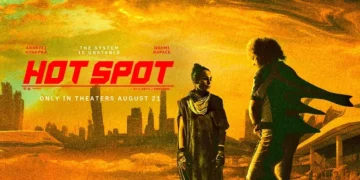













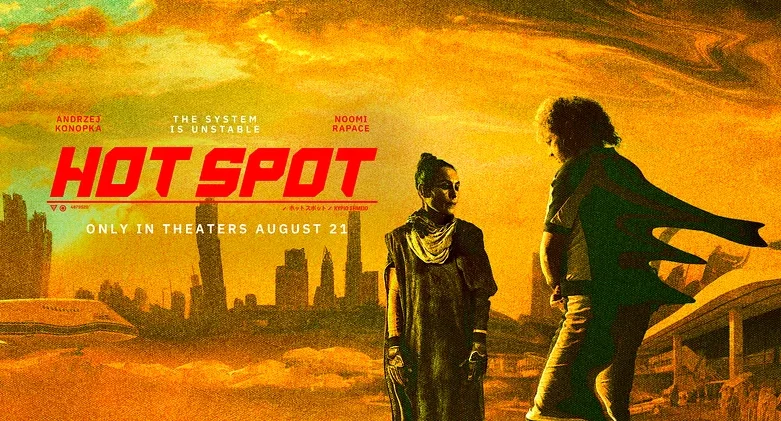
In 2012, the dystopian genre surged in popularity among young adult audiences with films such as The Hunger Games, Divergent, and The Maze Runner. More than a decade later, Polish filmmaker Agnieszka Smoczyńska and writer Robert Bolesto enter the genre with Hotspot, an ambitious Polish-English science-fiction dystopia that imagines a society somewhere in an unspecified future or, as the film puts it, “nowhere in the future.”
At the center of this strange and vividly constructed world is Djonny (Andrzej Konopka), a detective clad in a skin-tight jumpsuit and sporting a curly frohawk, who is dispatched on a special investigation to “help find the murderer.” What initially appears to be a straightforward murder investigation soon becomes something far more existential as Djonny begins questioning the very society he has been tasked with protecting.
This is a world governed by an artificial intelligence known simply as “the Head.” To some, the Head is essentially a deity; to others, it is merely a machine. Humanity has adapted to this technological regime in increasingly invasive ways. Citizens communicate telepathically through microchip implants, flesh-eating worms roam the landscape, driverless cars dominate the roads, and even basic resources such as water and energy have become precious commodities—the society’s “greatest goods.”
Djonny is sent to investigate a community resisting extinction amid dwindling resources and refusing to submit to the authority of the Head. Hotspot begins to reveal its more provocative ideas about technological authoritarianism, resource scarcity, religious devotion, and the boundaries between humanity and artificial intelligence. Those who violate the system’s laws are detained and converted from energy into water, turning human existence itself into a resource to be harvested. As Djonny becomes increasingly exposed to the realities of this society, his investigation evolves into an awakening, forcing him to confront the morality of the system he serves.
Hotspot embraces an aggressively stylized aesthetic, combining female nudity, dismembered bodies, neon-lit musical performances, eccentric costumes, and surreal imagery into an unmistakably strange cinematic universe. Its production design and art direction are among its greatest assets, constructing a world that feels indebted to the lurid excess of 1980s cyberpunk while maintaining its own distinctly European sensibility. The wardrobe, lighting, and visual effects further reinforce the film’s commitment to creating something unconventional.
The performances are equally committed, with Konopka anchoring the film through Djonny’s gradual transformation from dutiful detective to increasingly skeptical outsider. The score also contributes to the film’s peculiar atmosphere, complementing its neon-soaked environments and heightened visual language. Yet for all of its visual invention, Hotspot ultimately struggles to give its ideas the narrative architecture they deserve.
The film’s biggest weakness is its execution; the storytelling frequently feels discombobulated, introducing intriguing concepts without fully developing their implications. The world-building is dense with possibilities, but many of those ideas remain tantalizing fragments rather than fully realized components of the narrative. The film gives us flesh-eating organisms, brain implants, resource commodification, artificial intelligence, telepathy, and bizarre social hierarchies, but rarely allows these elements enough room to develop into a cohesive thematic plots.
Even the film’s most striking visual choices can begin to feel ornamental rather than purposeful, intrinsically disconnected to the story. At times, Hotspot seems more interested in showing us how strange its world can look than interrogating what that strangeness actually means.
Dystopian science fiction works best when its imagined future feels like an unsettling reflection of our present, and ultimately that is where the film loses some of its potential. Hotspot certainly gestures toward contemporary human life, but because its screenplay rarely develops these ideas beyond their initial introduction, the film’s commentary feels more suggestive than incisive. Ultimately, Hotspot is a fascinating world in search of a stronger story, an ambitious piece of dystopian sci-fi whose imagination often exceeds its execution.