














Eighteen years after the original Camp Rock, summer is officially back in session. Directed by Veronica Rodriguez and written by Eydie Faye, Camp Rock 3 returns to the beloved Disney musical franchise with a new generation of campers ready to inherit the legacy of the summer camp that launched some of Disney’s biggest young stars.
At the center of the new generation is Sage (Liamani Segura), a bold and determined singer who arrives at Camp Rock with the reverence of someone stepping onto sacred ground. “I’m where I’m supposed to be. All our favorite artists spent their summers here. Camp Rock is basically a historical landmark,” she declares. In many ways, that sentiment reflects the film itself: Camp Rock 3 treats its predecessor less like an old movie and more like a piece of pop-cultural history.
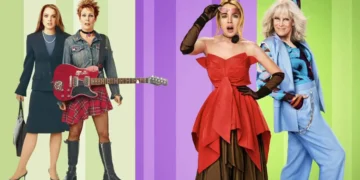
Sage arrives alongside her easygoing brother Desi (Hudson Stone), joining a colorful ensemble of campers that includes Fletch (Malachi Barton), the resident “bad boy” whose mannerisms amusingly recall a young Joe Jonas; Rosie (Lumi Pollack), a cello prodigy who hides behind her instrument while secretly yearning for the spotlight; Cliff (Casey Trotter), the overly involved drummer; Callie (Brooklyn Pitts), a standout dancer and choreographer; and Madison (Ava Jean), the social-media influencer whose enormous following gives her an inflated sense of authority. Because, naturally, every summer camp needs its resident mean girl.
The film’s new ensemble brings plenty of energy, and Camp Rock 3 makes a conscious effort to establish its new generation within the cultural language of today. The dialogue is peppered with Gen-Z terminology—“it’s giving,” “vibe,” and even a bootleg Spotify-like playlist known as “Sage Mix.” Madison’s enormous online following becomes a source of both power and insecurity, establishing social media as one of the primary distinctions between this generation of campers and the one that came before them. Yet the film ultimately argues for stepping away from that digital culture. Camp Rock operates under a simple set of rules: no phones, no posts, no leaks. The camp’s philosophy is that life is better experienced “face to face, not screen to screen,” a particularly fitting sentiment for a franchise that originated in an era before social media completely transformed how young performers experienced fame.
In an industry where young artists can be defined by follower counts, viral moments, and online visibility before their talent is ever fully developed, Camp Rock 3 makes a surprisingly earnest argument for the value of creating simply for the sake of creating. Camp is not supposed to be an influencer convention, but a place where young artists can experiment, fail, collaborate, and discover who they are without an audience constantly watching.
The Jonas Brothers’ storyline parallels the teen campers’ struggles with the complication of intersection of family, friendship, and creative partnership. The emphasis on community over competition becomes one of the film’s strongest thematic threads. Lark (Sherry Cola), the somewhat frazzled tour assistant accompanying the Jonas Brothers, attempts to prepare the campers for the realities of professional performance, reminding them that touring is far removed from the fantasy of stardom: late nights, cramped spaces, and terrible food.
Sage, too, arrives at camp with a singular devotion to her ambition; “I put my dream before everyone else. Music was all I ever needed,” she admits. Talent may get you onto the stage, but learning how to collaborate, compromise, and make room for other people is what allows you to remain there. That philosophy is mirrored by the return of the franchise’s original stars. The Jonas Brothers have grown into established adults with careers and families of their own. Jason is now firmly in fatherhood mode, Nick has become a movie star, and Joe remains recognizably Joe. The film cleverly acknowledges the real-life evolution of the brothers while incorporating those changes into their fictional counterparts. Their return is tied to a Connect Three tour and the search for a new opening act—a performer capable of embodying the kind of triple-threat talent necessary to share the stage with them. Their presence initially feels like the arrival of royalty as the new campers treat them as Camp Rock legends. Nearly two decades have passed since the original film, and the characters who once represented the future of musical stardom are now the established artists responsible for guiding the next generation toward it.
That transition is further embodied by Connie Torres (Maria Canals-Barrera), Mitchie’s mother and now the director of Camp Rock. Having witnessed how profoundly the camp changed her daughter’s life, Connie now occupies the role of mentor, preparing to watch that same transformation happen for someone else.
The film is saturated with callbacks to the original movies, from familiar chants and choreography to reimagined versions of beloved songs. Even the classic catchy tune “Brand New Day” receives a new-generation rendition. For longtime fans, these moments function almost like a cinematic scrapbook and affectionate reminders of where the franchise began and how much time has passed since audiences first watched Mitchie find her voice.
At times, however, the nostalgia becomes almost too conspicuous. There are so many callbacks that the film occasionally risks feeling less like a new chapter and more like a carefully assembled collection of memories. The references are often charming, but they can also make the film feel overly dependent on the emotional investment audiences already have in the franchise. For a franchise whose cultural legacy was built largely through its songs, the new music should be the element that most convincingly establishes this new generation. Unfortunately, the original songs remain far more memorable. While Camp Rock 3 introduces new material, very little of it left a lasting impression on me. By the time the credits rolled, I could already hear the original soundtrack in my head, while the new songs had largely faded into the background.
Camp Rock 3 quietly asks a more mature question beneath all the colorful camp theatrics: What happens when a dream you once shared begins to evolve differently for everyone involved? Demi Lovato’s surprise cameo is positioned as a bridge between the franchise’s past and present. Her brief return is admittedly far too short to carry the emotional weight the film seems to assign to it, but her presence reinforces the idea that Camp Rock exists as a continuum. She returns not because she needs the stage, but because she understands what the place represents. “This view never gets old. It’s so good to be back, especially with you guys,” she reflects. The franchise is no longer about Mitchie trying to find her voice. It is about what happens after she finds it—and whether she can make room for someone else’s, “you’ll always be Camp Rock’s star, and now it’s their turn.” The original campers have grown up, their lives have expanded beyond the high and notes at summer camp.
Camp Rock 3 recognizes that legacy is not about endlessly recreating the past, but allowing the next generation to take what came before and make it their own. The film is built around youthful exuberance, and the torch being passed from one generation of Disney performers to the next. The camp is still rocking, and it is now their turn to find the music in their souls
CHRISKRATING★★★