
















Family Feuds,
 Premiere Date: March 11, 2026
 Where to Watch: Prime Video
 Genre: Crime, Drama, Mystery
 Number of Episodes: 8
 Runtime: 49-60 minutes
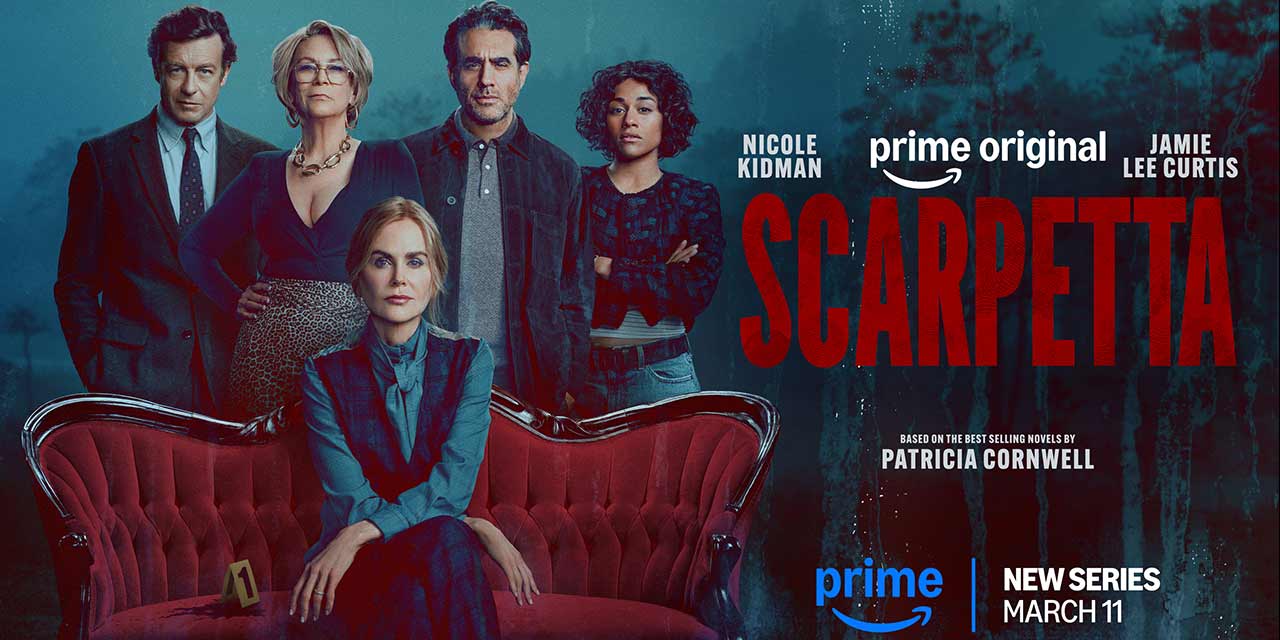
Patricia Cornwell’s long-running murder mystery Scarpetta makes the transition from page to screen under showrunner Liz Sarnoff. As the tagline declares, “for women, by women,” a sentiment that resonates throughout the series, which is led by two formidable Hollywood veterans: Nicole Kidman and Jamie Lee Curtis.
The gritty thriller follows Kidman as the brilliant chief medical examiner Dr. Kay Scarpetta, who returns to Virginia determined to once again serve as the voice of the victims, track down a brutal serial killer, and prove that the case that defined her career 28 years ago will not ultimately become her downfall. Her return represents a second chance both professionally and personally, after the messy unraveling of her most high-profile investigation more than two decades earlier. As one colleague remarks upon her arrival, “Good to have you back, Doc. Nothing has been the same since you’ve been gone.”
Curtis, in contrast, portrays Scarpetta’s sister Dorothy; vain, chaotic, and deeply dependent on male validation, who has nonetheless achieved remarkable success as a twenty-time bestselling children’s book author. Despite her accomplishments, Dorothy’s personal life is fractured, particularly in her strained relationship with her daughter Lucy (Ariana DeBose), who is still mourning the loss of her wife Janet. Janet’s memory lingers in an unusual form: an artificial intelligence reconstruction designed to preserve her presence. In the wake of this tragedy, the sisters reunite and move in together for Lucy’s sake, creating a living arrangement where, as one character puts it, “it’s family time all the time—for better or worse.”
The narrative unfolds across dual timelines set in both the present day and the 1990s. In the earlier timeline, a younger Kay Scarpetta, played by Rosy McEwen offers insight into the formative experiences that shaped her path and ultimately led to the events unfolding in the present.
As the series progresses, it explores several thematic strands: sibling rivalry, fractured family dynamics, feminism and patriarchal structures within the criminal justice system, and the uneasy relationship between the living and the dead. The show does not shy away from confronting difficult subject matter, addressing issues such as workplace sexism, sexual assault, domestic violence, and murder. At its core, Scarpetta positions itself as a distinctly feminist narrative. As Scarpetta herself warns, “Next Friday another woman could die,” underscoring her relentless commitment to protecting women and giving a voice to victims who can no longer speak for themselves.
CHRIS CRITIQUES
Shifting between present day and the 1990s—where Rosy McEwen delivers a standout performance as a younger Kay Scarpetta—the series struggles under the weight of its own sprawling ensemble. With so many characters competing for attention, the narrative rarely finds the focus it needs to feel cohesive. Instead of developing into fully dimensional figures, many supporting players come across as exaggerated personalities, their scenes often erupting into emotionally overwrought exchanges filled with shouting matches and performative tears.
The series finds far stronger footing in its past-set storyline. In these moments, McEwen injects the show with an urgency and authenticity that the present-day narrative frequently lacks. Her Scarpetta exists in a professional environment that constantly questions her competence. From workplace sabotage—such as her computer being hacked—to the casual dismissiveness of male colleagues, the younger Scarpetta is repeatedly forced to prove her worth in spaces that are predisposed to doubt her. McEwen conveys this struggle with subtle control, allowing the character’s frustration and determination to simmer just beneath the surface.
While the character speaks with unwavering confidence, McEwen’s physical performance reveals a deeper unease beneath Scarpetta’s composed exterior. That internal tension makes her compelling to watch—something noticeably absent from the older iteration of the character. One of the defining appeals of the thriller genre lies in protagonists who carry their own psychological scars, characters whose imperfections make their pursuit of justice feel personal and urgent.
Yet the series often sidelines its central figure. Instead of centering Scarpetta’s investigative journey, the narrative becomes entangled in a detective drama that veers dangerously close to soap opera territory. Scenes unfold in brightly lit kitchens and domestic spaces, where drawn-out family conflicts dominate the screen. The result is a show that devotes far more attention to convoluted interpersonal drama than to the darker, more intriguing elements of its mystery.
The series manages to recover some momentum in its closing stretch, where the story’s more compelling elements finally begin to surface. Perhaps that late resurgence explains why the show was granted a two-season commitment from the outset. By the time the final episodes arrive, Scarpetta hints at the sharper, more engaging thriller it could eventually become.
 Audience Match
If you like: Under the Bridge, Presumed Innocent, 56 Days, this is likely for you.
Best For: Viewers who love courthouse crime dramas or book to television adaptations.
Not For: Anyone who prefers stronger storylines and developed plots.
Final Verdict: Skip or Stream?
SKIP IT
The crime murder-mystery genre is on the rise and there are just far more series out there with fresher storytelling.