

















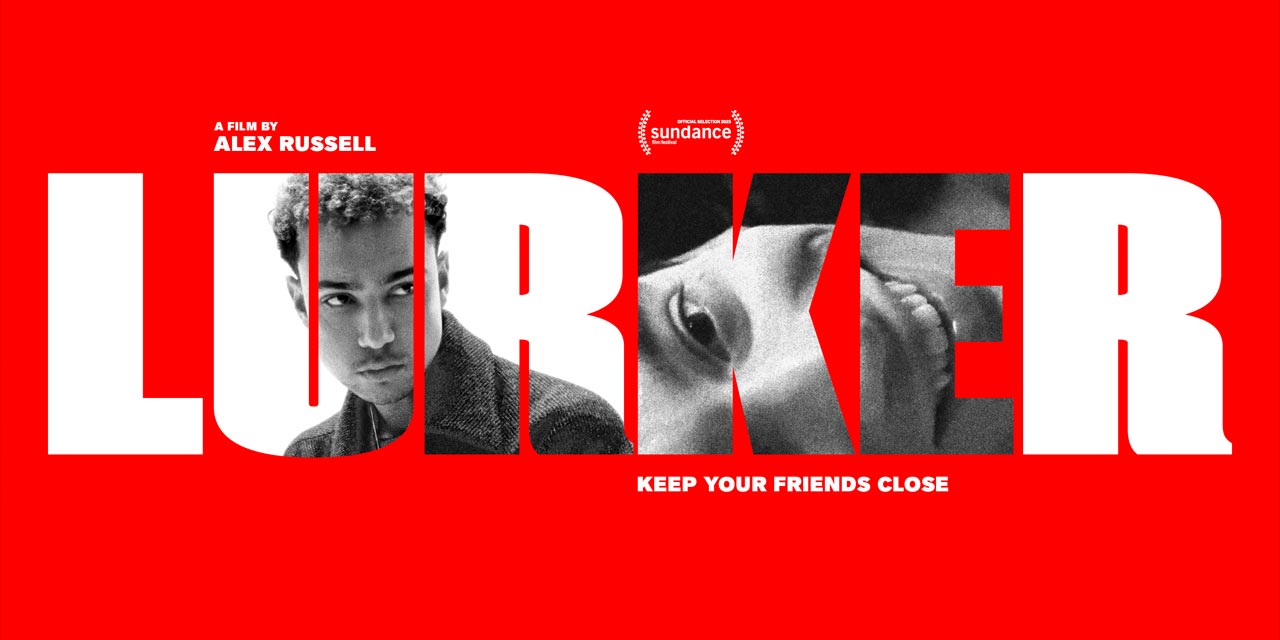
The term lurker dates back to the 14th century, but in Webster’s Dictionary it’s defined in a modern context as “a person who reads messages on an Internet forum or social media platform but does not contribute.” Online culture has stretched that definition further—someone who quietly observes, or in darker cases, obsessively stalks. We’ve all “lurked” before: on an ex’s page, a long-lost friend’s feed, or even a pop star’s account. That everyday behavior becomes the seed of something stranger in Alex Russell’s uniquely peculiar psychological thriller Lurker.
The film follows retail worker and loner Matthew Morning (Théodore Pellerin), who worms his way into the entourage of rising pop musician Oliver (Archie Madekwe). Initially an outsider, Matthew begins shaping Oliver’s visual world, soon dubbed the “tour guy with a porno camera.” He insists he isn’t just another obsessive superfan, claiming he barely knew Oliver’s music beforehand. Oliver, for his part, seems charmed by Matthew’s presence, even praising him as a “real person” who actually listens, unlike the endless phone-wielding Gen Z fans chasing content over connection.

Russell situates this story in the cultural stew of Los Angeles, where dreamers, influencers, and artists collide. Oliver’s “band of brothers” illustrates both the intoxicating pull of fame and the parasitic nature of proximity: friends who serve as yes-men, chasing scraps of validation while propping up Oliver’s ego. At one point, Oliver casts himself as a kind of messianic figure during a music video shoot with sheep, proclaiming, “Got Matthew and my disciples with me.” The biblical undertones, paired with the group’s habit of calling one another “brother,” “son,” and “dad,” only heighten the cult-like intensity of this entourage.
Matthew, however, wants something different, or perhaps, more. Unlike the usual five-year-plan answers that include marriage, stability, and career, his ambitions are rawer, desperate: he craves recognition and significance. “The rest of us all want the same thing,” he says. “I just want it more, and I’m better.”

Lurker becomes a tense tango between Matthew and Oliver, a hypnotic weave of seduction, power, and obsession. Los Angeles, in this telling, is less a backdrop than a mirror: a land of lurkers, wannabes, and B-list boy bands, where the line between love and obsession smolders into flame.
Both leads deliver commanding performances, grounding the story’s surreal energy with vulnerability and nuance. While the Los Angeles setting is present, Russell resists overindulging in city stereotypes, letting the dynamic between Matthew and Oliver take center stage. The fictional pop music, especially Madekwe’s “Love and Obsession,” adds an authentic layer, a perfect example of an actor fully committing to the creation of a believable pop persona.

The film’s one drawback is its brevity. An additional 20 minutes might have given its themes and characters more room to breathe. Yet even with its open-ended conclusion, Lurker sticks the landing. Its final twist sharpens the character dynamics into something unexpectedly chilling, closing on applause that feels both triumphant and unsettling.
In the end, Lurker lingers like its title suggests, asking the audience: how far are you willing to go to be seen, heard, or remembered?








Now this sounds like a good psycho thriller I’d love to give a watch!