

















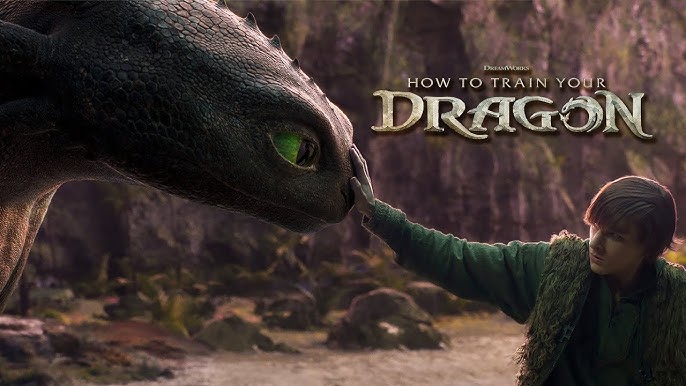
How to Train Your Dragon soars as a faithful and visually arresting adaptation that captures the heart of its animated predecessor. As someone who grew up with the original, though it never quite held a place among my personal favorites, I approached this reimagining with cautious curiosity. What I found was a thoughtful translation that not only honors the spirit of the source material but subtly enriches it.
The night before my screening, I revisited the 2010 classic to reacquaint myself with the world of Berk. To my surprise, the live-action version felt less like a mere remake and more like a storybook come to life. It was akin to flipping through the pages of a childhood favorite and suddenly watching your imagination rendered in striking, cinematic reality.
Adapted from Cressida Cowell’s 2003 novel and helmed by Dean DeBlois—who also directed the original animated trilogy. Hiccup (Mason Thames), a young Viking misfit, upends his tribe’s legacy of dragon hunting when he forms a quiet, compassionate bond with Toothless, a rare Night Fury. What unfolds is a coming-of-age tale that reframes difference not as weakness, but as a catalyst for change.

The film opens with a strong introduction that immediately sets the tone. Hiccup’s journey is as much internal as it is external—his greatest battle is with acceptance. As the son of the stoic chief Stoick the Vast (Gerard Butler), Hiccup is seen as unworthy, too soft, too unconventional. He struggles to live up to his father’s expectations, and this tension reaches a powerful emotional apex, especially poignant considering the film’s release close to Father’s Day. Their dynamic is a touching portrayal of generational conflict and the desperate need for validation.
Themes of identity, courage, and nonconformity permeate the film. The parallel between Hiccup and Toothless, the boy and the dragon who both fear yet yearn to be understood forms the emotional spine of the story. The metaphor of the “hunter becoming the hunted” plays out with nuance, as Hiccup questions the cycle of violence. “If we keep killing one another, what’s left?” he asks, challenging his people to consider peace over fear.

Visually, the film is a mixed bag. The village of Berk is brought to life with detailed props and immersive town design, though the broader landscapes sometimes fall short in texture and realism. Still, the flight sequences are breathtaking—dynamic, exhilarating, and surprisingly emotional, evoking the thrill of a 3D roller coaster ride.
The costume design is where this adaptation truly shines. Astrid, played by standout Nico Parker, wears intricately braided hairstyles that pay homage to Black cultural heritage while seamlessly integrating into the Viking aesthetic. Parker brings layers to Astrid’s bold and determined persona, grounding her in quiet strength. The ensemble cast is richly diverse, a quiet but meaningful shift from previous iterations, reflecting a broader range of representation without feeling forced.
:max_bytes(150000):strip_icc():focal(783x236:785x238)/nico-parker-how-to-train-2-061025-afaa6a293f6045c4a95b45400327f53b.jpg)
Critics of the casting might decry so-called “diversity hires,” but the truth is that fictional characters aren’t bound by race, and this adaptation proves that diversity can deepen rather than distract from storytelling. Parker’s Astrid is layered, nuanced, and vital to Hiccup’s emotional journey.
The soundtrack is a nostalgic treat, with the signature themes returning to tug on longtime fans’ heartstrings. The classic motifs return with full cinematic flourish, elevating key scenes with emotional resonance.
There are clever nods for adult viewers too, including light humor that slips past younger audiences (“half of her breastplate—it keeps her close” is one of those lines that gets a chuckle from grown-ups). Whether you’re discovering Berk for the first time or revisiting it through older eyes, this film is built for all ages.

There’s a childlike wonder in seeing beloved animated moments come to life, especially for those of us who grew up with the franchise. It’s rare for a live-action adaptation to retain the magic of its predecessor while adding new layers, but this film accomplishes just that.
In the end, How to Train Your Dragon may just be the most successful animated-to-live-action adaptation to date. It’s a soaring adventure filled with heart, heroism, and the kind of wonder only dragons can bring. As the film says: “Other places may have ponies or puppies—we have dragons.”