
















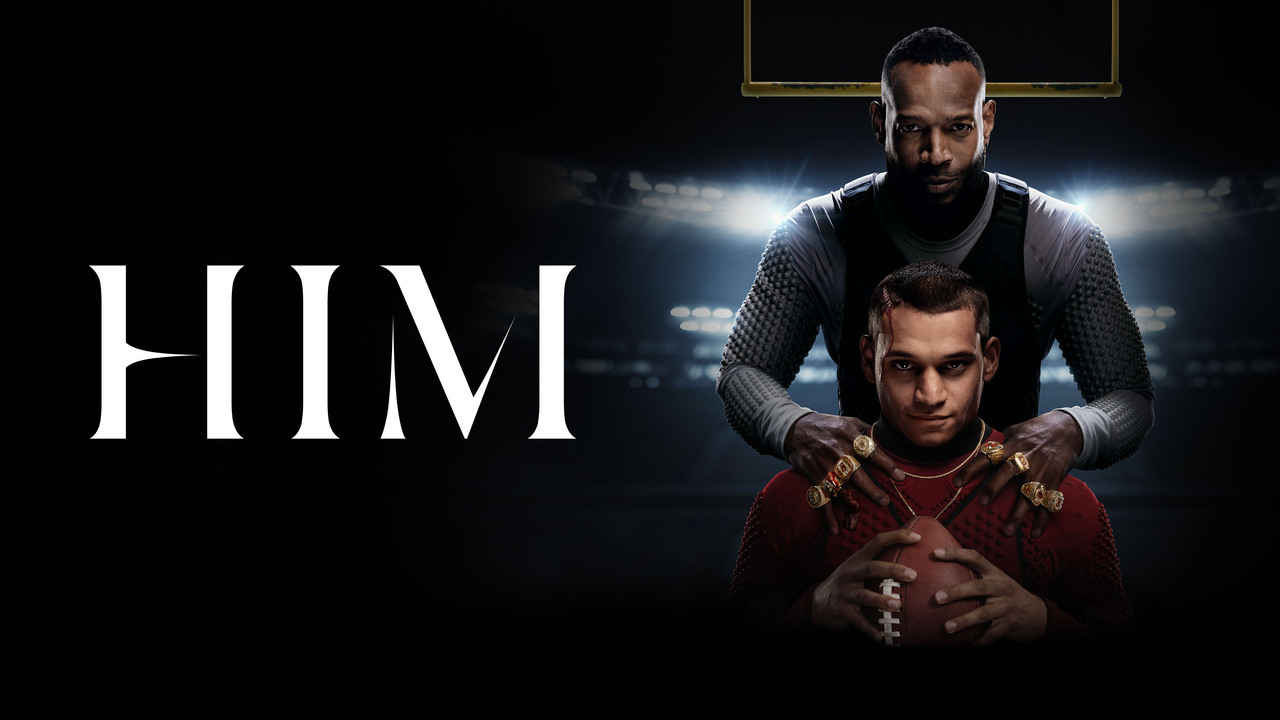
The slang term “Him” emerged from sports culture, shorthand for the rare athlete whose dominance elevates them above their peers. In Justin Tipping’s horror thriller HIM (co-written with Skip Bronkie and Zack Akers), the word evolves into something darker: a study of worship, exploitation, and the sacrificial machinery of American sports, particularly for young Black men.
Cameron “Cam” Cade (Tyriq Withers) is introduced as a dreamer, watching his beloved San Antonio Saviors secure a championship, only for his idol, quarterback Isaiah White (Marlon Wayans), to suffer a brutal, career-threatening injury. For Cam’s father (Don Benjamin), the lesson is clear: “No guts, no glory.” Masculinity, value, and even love are contingent on sacrifice. Years later, when Cam himself is attacked by a goat-masked assailant and sustains a devastating injury, his path toward becoming “Him” begins. His girlfriend Jasmine (Heather Lynn Harris) insists that there is more to life than football, but in his father’s world, greatness is not a choice, it is a mandate.
The figure of Isaiah looms large, not only as a mentor but as a messiah. Fans worship him with cult-like devotion, chanting “Isaiah is the chosen one” in grotesque parades. His home, shaped like a cross, doubles as a shrine, a chapel of rings, carcasses, and relics of conquest. Training with Isaiah initiates Cam into a six-part ritual (Fun, Poise, Leadership, Resilience, Vision, and Sacrifice), each stage designed to strip him down and rebuild him as something more than human, yet less than free. Football here is not a game but a religion: intoxicating, violent, and cannibalistic.
The film is saturated with religious symbolism. Cam clutches his crucifix before each game; Isaiah dons a single golden cross earring, while free-agent recruits bear tattoos proclaiming FAITH. The mantra “Football, family, God” reverberates like scripture, blurring devotion to faith with devotion to spectacle.
One of the film’s sharpest visual metaphors comes in an abandoned building, its broken signage reading “creation” instead of “recreation.” A reminder of how sports culture reshapes young men into products rather than people. Cam, suffocated by vices—drugs, alcohol, sex, and the women that orbit fame, clings to his gold crucifix necklace as a lifeline. But at a pivotal party, it’s stripped away, replaced with oversized diamond chains, a hollowed-out symbol of status. He vomits icy jewels, a dark yet striking embodiment of excess and the cost of assimilation into this manufactured idea of greatness.
It’s here that HIM reveals both its strength and its weakness. Justin Tipping has an undeniable eye for visuals, often composing shots that could stand as music videos in their own right. But too often, the imagery, compelling as it is, goes unexplained or underdeveloped. The result is a film bursting with symbols, yet light on the connective tissue that would make those symbols land with full force.
Visually, HIM is stunning. Kira Kelly’s cinematography (she also lensed Queen & Slim) imbues the film with a feverish, surreal intensity, from thermal imaging sequences to dreamlike tracking shots. The needle-drop soundtrack, from Gucci Mane’s Lemonade to pulsing rap anthems, amplifies the sensation that we are watching not just a film but an initiation, sports highlight reel, and ritual sacrifice.
Where the film falters is in its script. The imagery is rich, but the ideas about exploitation, racialized expectation, and the commodification of athletes are often gestured toward rather than interrogated. Dialogue is sparse, leaving silence where complexity should be. At its weakest, HIM feels like a collection of striking tableaux stitched together rather than a cohesive narrative. When the league declares, “We groomed you since you were a child, we attacked you so we could isolate you and draft you,” the line cuts deep, but the screenplay never lingers long enough for the weight of that exploitation to fully sink in.
And yet, as flawed as it is, HIM is undeniably bold. It is a horror film that understands the brutality of sports culture better than many dramas, and its willingness to treat football as a site of worship, sacrifice, and death makes it both provocative and timely.
If sports are America’s most devout religion, HIM reveals the altar is built on the bodies of young Black men asked to be more than human. The film doesn’t always land its narrative plays, but the bruises it leaves are impossible to ignore.