













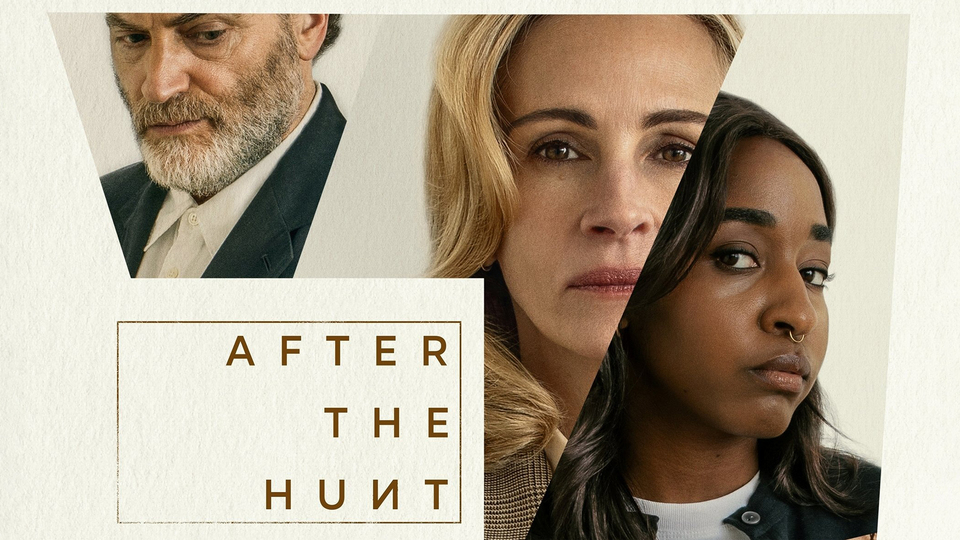
“It happened at Yale.” Those four words hang heavy over After the Hunt, Luca Guadagnino’s latest film. A sleekly mounted, coldly cerebral academic drama that wades into the murky waters of sexual assault, accountability, and moral performance. For a director who built his reputation on sensuality and atmosphere (Call Me by Your Name, Bones and All), Guadagnino’s touch here is noticeably restrained, perhaps too restrained for the rawness this story demands.
Guadagnino reteams with longtime collaborators Trent Reznor and Atticus Ross, whose uneasy, pulse-like score hums beneath every confrontation like a lie waiting to be told. Every frame, courtesy of the director’s unmistakable visual precision, feels intentional: the lighting icy, the wardrobe reflective of character psychology, the camera lingering just long enough to make you squirm. It’s a masterclass in composition, but not always in connection.
Andrew Garfield plays Hank, a beloved Yale professor accused of sexual misconduct, the kind of man “everybody loves,” as one character puts it. Garfield’s performance is unnervingly effective; his Hank is equal parts charming and chilling, the kind of predator who hides behind intellect and social goodwill. He’s constantly smoking, drinking, deflecting, living in denial while convincing himself he’s the victim. “I’m damned if I do, damned if I don’t,” he mutters, with just enough self-pity to be dangerous.
Julia Roberts anchors the ensemble as the conflicted mentor caught between loyalty and justice, but the film’s dialogue heavy with philosophical musing and academic jargon, too often distances rather than deepens. Conversations feel staged for symposiums, not cinema. “You will not allow what is correct keep you from doing what is right,” one line insists, but the writing doesn’t always live up to its own provocation.
Ayo Edebiri delivers quiet intensity as a Black student whose accusation sparks the moral unraveling of the story, yet her perspective and the intersection of race within institutional power is frustratingly underexplored. For a film so intent on dissecting systemic rot, After the Hunt feels surprisingly surface-level when it comes to who actually bears the weight of these systems.
Cinematographer Sayombhu Mukdeeprom bathes scenes in stark contrasts, especially a moment where Roberts’ character muses, “I wonder if I can be cold sometimes,” while standing in an icy-blue kitchen. It’s one of the few instances where image and dialogue converge to say something haunting about complicity. But too often, the film confuses intellectualism with insight.
Guadagnino’s direction is assured, but the script’s pretentiousness saps the emotion. There are fleeting moments of brilliance, the score tightening during moral uncertainty, the claustrophobic Yale interiors echoing privilege and repression, but they never coalesce into something deeply felt.
For a film tackling sexual assault, After the Hunt is strangely unmoving. Its detachment might be intentional, but it leaves viewers at arm’s length from pain that should pierce. It’s a conversation starter that forgets to make you feel the weight of the conversation.
Visually striking yet emotionally sterile, After the Hunt has the architecture of a great film but the soul feels missing. It’s not without merit, but for Guadagnino, this may be his most ambitious misfire.