

















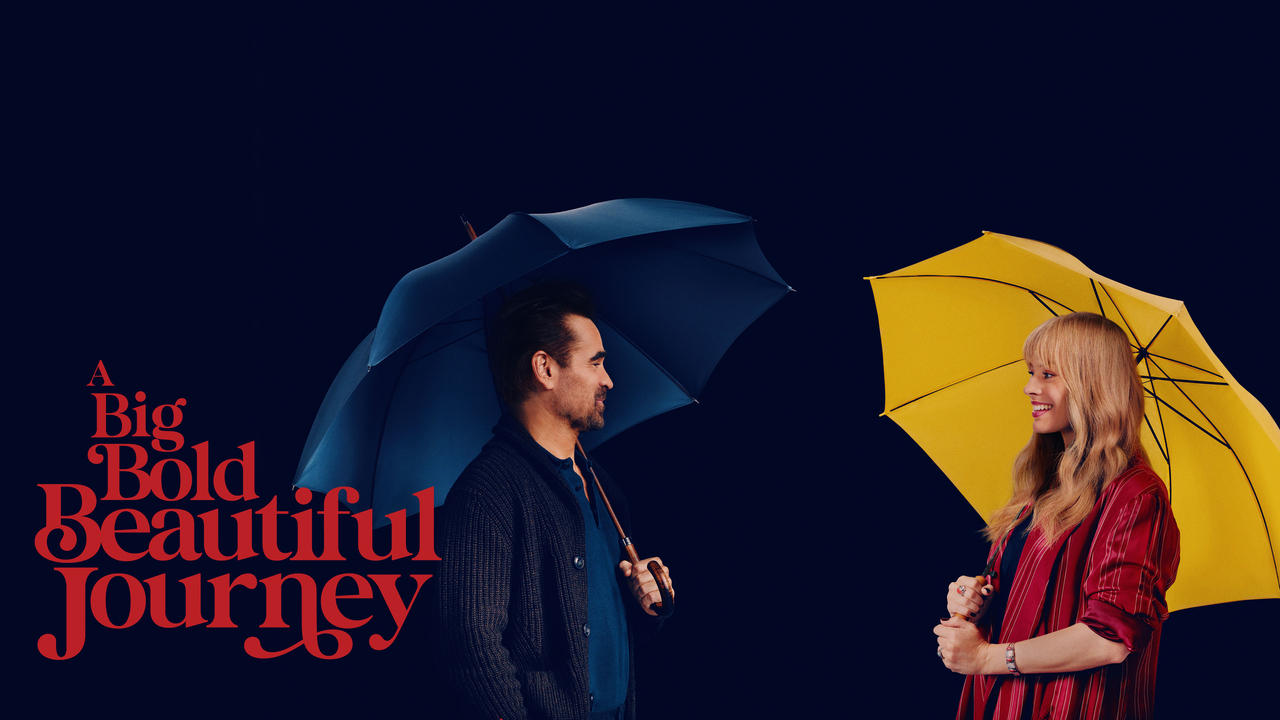
With a title as ambitious as A Big Bold Beautiful Journey, expectations for an emotionally rich and inventive film are high, but this romantic fantasy struggles to live up to its promise.
Kogonada’s latest, written by Seth Reiss, follows long-time singles David from the South (Colin Farrell) and Sarah from Downtown (Margot Robbie), two city dwellers whose paths finally cross at a mutual friend’s wedding. David is a hopeless romantic, while Sarah is romantically stunted, lamenting, “You have destroyed some men, and some men have destroyed me.” Yet beneath their differences, they share a quirky, secretly dorky side that the film tries—and largely fails—to capitalize on. Their “journey” feels uncertain, as the destination the film is aiming for remains unclear.
The story hinges on a mysterious car rental agency that functions like a soulmate service. David and Sarah are each handed rental cars outfitted with GPS, every stop leading them deeper into a curated journey, one that promises connection but often feels more like “rent cars and wreck lives.”
Sarah, for all Margot Robbie’s charm, is written so self-deprecating that her endless cycle of “let’s not do this because we’ll only hurt each other” speeches quickly grows exhausting. Love, after all, is about open doors and taking risks, a sentiment the film itself seems unwilling to embrace.
Characterization, meanwhile, is reduced to broad strokes: Sarah is the type of woman who cheats and disappears in the middle of the night, while David is the archetypal hopeless romantic who sabotages himself. He ends engagements out of unhappiness, pines after women who don’t reciprocate, and convinces himself he can love someone into fulfillment. Their dynamic might have worked with sharper writing, but here it collapses under repetition and cliché.
Visually, the film is meticulously crafted. The cinematography is precise, awash in vibrant yellows, blues, and reds, hinting at symbolic significance that never fully materializes. The score, composed by Japanese composer Joe Hisaishi, his first non-Japanese film release, is paired with songs by Laufey and Mitski; together, they imbue the film with a sense of intended profundity. Yet despite the lush visuals and evocative music, the emotional resonance never lands.
The film flirts with ambitious concepts: life as a stage, love that makes time stop, and the notion of performing to reach truth, but the execution is underwhelming. Character dynamics, even with massively talented stars like Farrell and Robbie, feel clichéd. Sarah’s complexity is reduced to the familiar trope of romantic trauma and parental issues, with her own moral ambiguity, and cheating as justification for being single. David embodies the archetypal down-on-his-luck good guy, a man whose heart is worn openly on his sleeve, yearning for a love that will finally meet him halfway. Their relationship lacks true nuance, and the dialogue between the potential couple often feels forced.
The film’s non-linear timeline makes it difficult to follow the sequence of events. The past, present, and future blur in ways that leave the audience disoriented. Ultimately, A Big Bold Beautiful Journey is a film with big ideas that feel small on the screen. It aims for profundity but falls short, leaving the promise of its ambitious title largely unfulfilled.