
















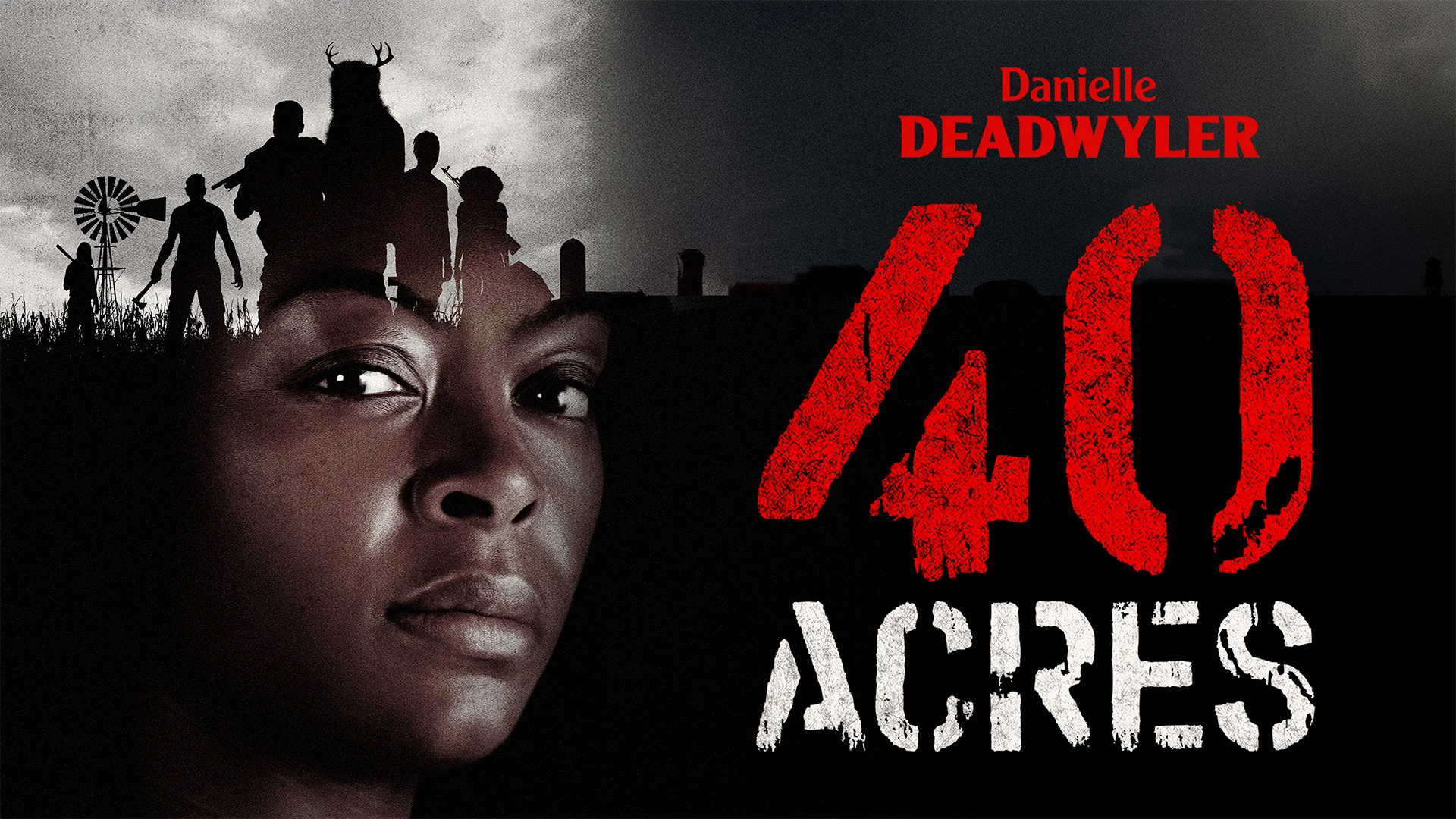
The title 40 Acres references the historic yet unmet promise made by Union General William Tecumseh Sherman on January 16, 1865: to grant formerly enslaved Black Americans forty acres of land. In this post-apocalyptic thriller, that promise becomes more than symbolic, it becomes the battleground. The film follows a survivalist Black farming family fighting not only to protect their land, but their lineage, in a world stripped of civilization.
Enter Danielle Deadwyler, Hollywood’s deadly but silent killer. Few actors can communicate devastation or determination with just a look, but Deadwyler has long mastered the art of quiet power. Once again, she slips seamlessly into a strong maternal role as Hailey Freeman, the steely matriarch of the Freeman Farm. Alongside her partner Galen (Michael Greyeyes), Hailey leads their children as the last surviving and thriving Black family in a famine-decimated world.
40 Acres unfolds in five chapters, painting a portrait of domesticity amidst chaos. The Freemans read aloud to sharpen their minds, hold ancestral ceremonies to preserve culture, and gather for tender family dinners—peppered, of course, with the occasional act of righteous violence. “Your brain’s gonna be fertilized all over my field,” Hailey growls. The Freemans aren’t just farmers, they’re warriors and freedom fighters.
But danger is never far. A hostile militia closes in, and a roaming pack of cannibals threatens to feast on those like the Freemans. “You eat people,” Hailey tells one of them. “While you just kill ‘em,” the cannibal counters, “or get your children to do it. The truth is, we’re more alike than you wanna admit.” At its core, 40 Acres asks: how far will you go to survive and who must you become in the process?

The Freeman Farm is hidden deep within a forest, far from society and unseen by the Union. Yet the greatest threat may come from within. Hailey’s eldest son, Emanuel (Kataem O’Connor), has reached that restless age where teenage yearning and a mother’s protection collide. When he meets a mysterious young woman (Milcania Diaz-Rojas) beyond the fence, his desire for connection threatens the entire family’s safety.
As any mother, especially a Black mother would, Hailey’s instinct is to guard her children from all threats, even if that means doing the unthinkable. She protects with the ferocity of history behind her. Yet Manny, on the cusp of manhood, begins shedding his boyhood skin. “You left me on a farm to fight in a war,” he says. “How am I supposed to survive without people? I can’t even talk to a girl.” There are flashbacks throughout the film to young Manny that echo that same childlike wonder: “Mom, I could never hate you. Everything you did was to help us survive. I just gotta find my own way now.”
This tension between control and freedom, survival and independence, mirrors Deadwyler’s earlier 2025 performance in The Woman in the Yard. In both films, she portrays mothers confronting moral gray zones to protect their children. Hailey’s fear is not just of the cannibals or the militia, it’s the fear every parent knows: that you won’t be there when your child needs you most.

40 Acres is a rare blend of action and sentiment. It’s not just about the end of the world; it’s about what you pass on. Hailey and Galen’s relationship, and their blending of Black and Indigenous traditions, becomes a source of strength. “I speak the language of my ancestors,” Galen says, there is beauty in the Black and Indigenous blending of family. They are raising warriors, not just in combat, but in memory, ceremony, and survival skills that will outlive them.
From the grounded cinematography to the use of lighting that evokes both dread and resilience, the technical elements of 40 Acres are meticulously crafted. The score swells and simmers in all the right places. And of course, Danielle Deadwyler carries this film with grace and gravitas, supported by a cast that holds their own in every scene.
There’s plenty of action, yes, but it’s the soul of this film that stays with you. 40 Acres is about land, legacy, and the people willing to die and live for both.