













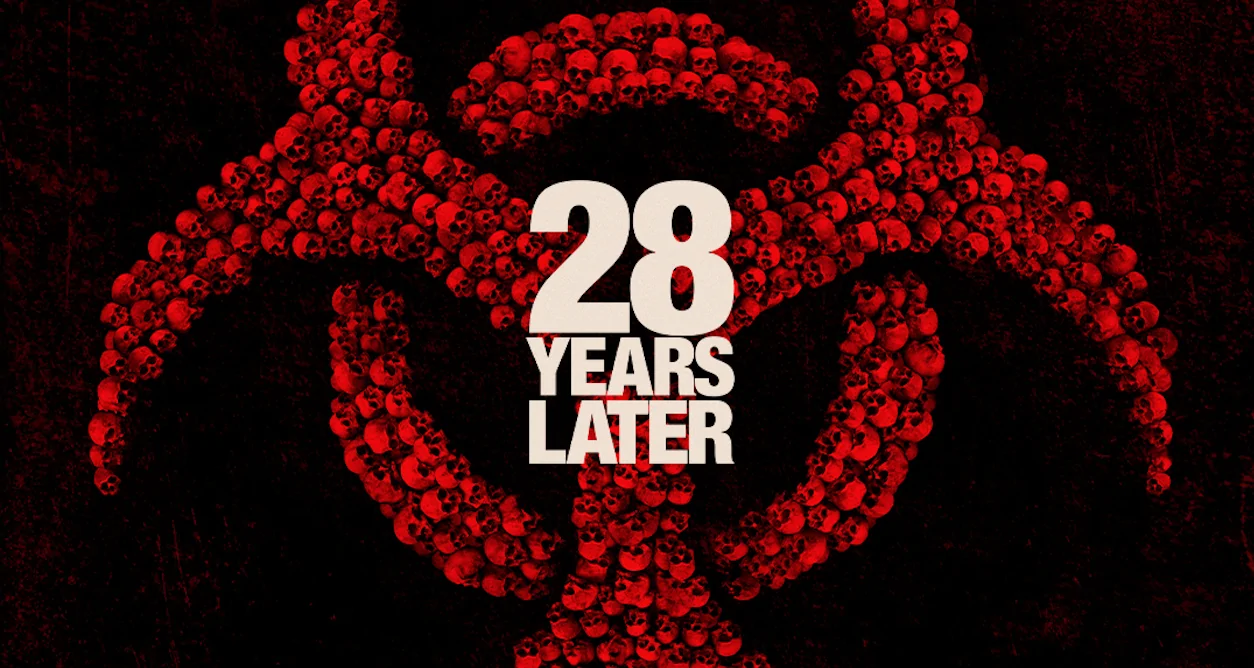
Over two decades since the original outbreak, the 28 Days Later franchise returns with its long-awaited third installment: 28 Years Later. Directed by Danny Boyle and written by Alex Garland, the film opens with a harrowing prologue in the Scottish Highlands. A young boy, Jimmy (Rocco Haynes), flees a violent encounter with his rage-infected family, his priest father offering a crucifix in one final act of protection. Cut to thirty years later—the Rage Virus has been eradicated across continental Europe, but the British Isles remain under strict quarantine.
Life continues in a self-contained settlement on Lindisfarne, where survivors like Jamie (Aaron Taylor-Johnson), his ailing wife Isla (Jodie Comer), and their son Spike (Alfie Williams) live under harsh rules and harder truths. A coming-of-age ritual demands that each child venture to the mainland at age 14 to complete a rite of passage: their first kill. With Spike’s turn approaching, father and son set off, Jamie telling him plainly, “Let’s go get your first kill.” It’s a chilling reflection of how desensitized humanity has become, fear replaced by tradition.

The mainland, overrun by the infected, is haunting. Spike’s innocence contrasts sharply with Jamie’s hardened pragmatism. Where Jamie sees “mindless flesh,” Spike sees terror and tragedy. Yet, in this world, manhood is earned through violence. “The more you kill, the easier it gets,” Jamie assures him, more threat than comfort.
What distinguishes 28 Years Later from its predecessors is the evolution of the infected. New variants emerge, including the cunning and brutal “Alpha,” a terrifying apex predator embodied by Chi Lewis-Parry, whose imposing presence dominates every frame.
A mysterious fire signals the reappearance of Dr. Ian Kelson (Ralph Fiennes), a feared recluse who holds secrets and perhaps hope. His presence becomes pivotal when Spike, desperate to save his mother, Isla, leads her back into the infected mainland in search of a cure. In one of the film’s most surreal and symbolic moments, Isla assists a laboring pregnant infected only for the newborn to emerge uninfected. The moment suggests a complex theme: that even in decay, traces of humanity persist.

There’s a quietly provocative undercurrent in how the UK remains the epicenter of chaos while the rest of the world has moved on. The island’s isolation is reflected not just geographically but culturally, from primitive weapons like bows and arrows to their survivalist aesthetic. It’s a compelling metaphor for neglect and systemic abandonment.
Visually, the film honors its roots. Shot partially on iPhones with custom multi-angle rigs, the grainy, raw aesthetic mirrors the original’s vérité style. This choice keeps the tension immediate and grounded. Performances are uniformly strong, with Aaron Taylor-Johnson and Ralph Fiennes offering weight, but it’s Alfie Williams who impresses most, anchoring the emotional core of the film with quiet strength and vulnerability well beyond his years.
28 Years Later breathes new life into the franchise with thoughtful world-building, layered performances, and a bleakly poetic exploration of legacy, survival, and what’s left of the human spirit after all else is stripped away. Where it goes from here is anyone’s guess—but if this installment is any indication, there’s still plenty worth unearthing in this world of decay.